
Introduction
Have you noticed that sometimes Google gives you answers directly on the search page before you even click on a website? That’s Google’s Search Generative Experience (SGE) in action — a major AI-powered update that’s changing how people search and how websites get traffic.
If you are a small business owner, startup founder, e-commerce seller, digital marketer, or even a student learning SEO, this change directly affects you.
In this guide, we’ll explain what SGE is, how it works, how it’s affecting SEO in India, and exact strategies you can use to stay ahead in 2025. We’ll also show real Indian examples and actionable tips for businesses of all sizes.
What Exactly Is SGE? (Simple Definition for Beginners)
SGE (Search Generative Experience) is Google’s AI system that gives users direct answers on top of search results.
Instead of just showing blue links, Google now: 
-
Reads multiple websites
-
Understands the user’s question
-
Generates a summarized answer
-
Offers follow-up questions
-
Often pushes traditional organic results lower
Example:
Searching “best social media marketing strategies in India” shows a detailed AI summary above all website results. Users get most information without visiting a website, which changes the way traffic flows.
Think of SGE as Google’s built-in AI assistant that delivers instant answers.
Why SGE Matters for Everyone
SGE isn’t just for marketers — it affects every person and business in India:
-
Small business owners: Fewer clicks to your website
-
Startups: Need detailed, trustworthy content to appear in SGE
-
E-commerce stores: AI-generated product suggestions influence purchases
-
Marketing managers: Must rethink SEO strategy from keyword-centric to intent-centric
-
Students: Quick answers for learning, reducing clicks to blogs
-
Local businesses: AI summaries of top stores reduce visibility unless optimized
SGE changes the game. Adapting now gives you a competitive advantage.
How SGE Works (Step-by-Step for Beginners)
Here’s a simple breakdown:
-
User types a query
Example: “best SEO agency in India”
-
Google detects intent
Is it informational, commercial, transactional? -
AI reads top websites
Google evaluates quality, authority, and trustworthiness. -
AI generates a summary
Answer appears at the top in a neat AI box. -
Follow-up suggestions appear
Questions like: “Which agency is best for small businesses?” or “SEO pricing in India?”
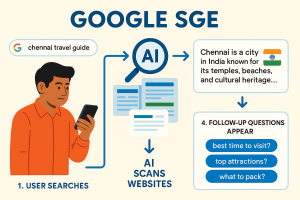
Indian Example: Searching “best budget smartphone under ₹15,000 in India” shows AI comparisons, specs, and pros/cons before any website link.
How SGE Is Changing SEO in 2025
SGE is reshaping SEO. Here’s what Indian businesses need to know:
Organic Traffic Is Dropping
Even if your site ranks #1, SGE often appears above your result, lowering clicks.
Indian Example:
A Delhi bakery ranks #1 for “best bakery in Delhi,” but SGE lists top bakeries directly. Website traffic drops 25–40%.
SEO Is Moving From Keywords → Intent
Old SEO relied heavily on keywords. Now Google prioritizes user intent.
-
Keyword-focused: “best shoes”
-
Intent-focused: “Which running shoes are best for Indian roads?”
Blogs need to answer real user questions, not just repeat keywords.
EEAT Is More Important Than Ever
SGE uses EEAT to select trustworthy content:
-
Experience
-
Expertise
-
Authority
-
Trustworthiness

Indian Example:
A Mumbai dentist with genuine reviews, credentials, and patient photos ranks higher than generic health blogs.
Actionable Tip: Add author bio, credentials, case studies, and testimonials to your content.
Long, Detailed Content Performs Better
SGE prefers well-structured, long-form content:
-
1500–2500 words
-
Step-by-step guidance
-
Real-world examples
-
Lists and bullet points
Short, generic blogs no longer get featured.
Example:
A blog on “Digital marketing pricing in India” with detailed pricing ranges, case studies, and tips will outrank short posts.
FAQs & Q/A Format Boost Visibility
SGE loves content in question-and-answer format.
Examples of Indian-targeted FAQs:
-
“Which is the best SEO agency in India?”
-
“How much does Google Ads cost in India?”
-
“How to promote a small business online?”
Add 5–10 FAQs per blog or page to increase chances of being featured.
Local SEO Is Changing
SGE combines AI with local SEO signals: 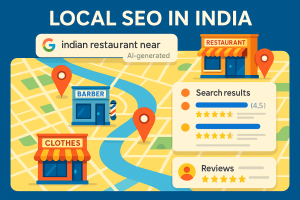
-
Reviews
-
Business info
-
Photos
-
Ratings
Example: Searching “best cafés in Bangalore” shows AI suggestions for top-rated cafés with addresses and reviews.
Actionable Tip: Keep Google Business Profile updated, encourage reviews, and maintain consistent NAP (Name, Address, Phone).
Structured Content Is Key
SGE prefers easy-to-read content:
-
Headings (H2, H3)
-
Bullet points & numbered lists
-
Step-by-step instructions
Poorly structured content loses visibility, even if the content is good.
Real Indian Examples of Businesses Affected by SGE
-
Local Electrician in Lucknow – lost 40% clicks after SGE appeared.
-
E-commerce store selling kurti sets – AI product comparisons reduced website traffic.
-
Digital marketing freelancer in Hyderabad – improved rankings after adding case studies, credentials, and FAQs.
-
Coaching center in Pune – increased visibility by updating FAQs and adding detailed content.
These examples show that EEAT + detailed content + FAQs are crucial to maintain visibility.
How Indian Businesses Should Adapt to SGE
Here’s a practical, step-by-step checklist:
Build Topic Clusters
Instead of single blogs:
-
Main topic: “Digital Marketing in India”
-
Subtopics: SEO, Google Ads, SMM, pricing, tools
-
FAQs: 30–50 relevant questions
SGE favors complete, authoritative topic coverage.
Improve Website EEAT
-
Add author name and bio
-
Include qualifications and case studies
-
Add real testimonials
-
Include India-specific examples
-
Display trust badges
Optimize for Conversational Keywords
-
“How to advertise a small business online in India?”
-
“Which SEO agency is best for startups?”
-
“Google Ads pricing in India”
Conversational searches align with AI intent.
Update Old Content
-
Expand short blogs
-
Add FAQs
-
Include Indian examples
-
Restructure content into headings, bullets, and lists
Create High-Quality Long-Form Content
-
1500–2500 words
-
Step-by-step, detailed, actionable
-
Real examples, numbers, case studies
Trafixo can help businesses create content that is SGE-ready and ranks higher.
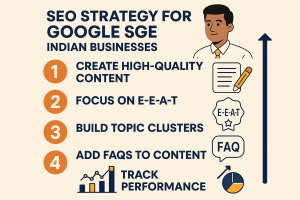
Practical SEO Strategy for 2025 (SGE-Compatible)
Follow this 6-step plan:
-
Choose a topic cluster
-
Write long, detailed content
-
Add Indian context and examples
-
Improve EEAT
-
Match search intent
-
Monitor SGE visibility using Google Search Console
Will SGE Kill SEO?
No. SEO is evolving, not dying.
-
Websites that adapt will grow
-
Thin, outdated content will lose traffic
-
Focus on EEAT + intent + structured content
Indian Example:
Two websites write about “social media marketing in India”:
-
One writes a 500-word post
-
One writes a detailed 2000-word guide with FAQs and examples
SGE will pick the second one every time.
Conclusion
SGE is a major shift in how Google works, especially for Indian businesses.
The good news:
Adapt early, write detailed content, show expertise, and include FAQs, and you’ll stay ahead.

Trafixo can help.
We create SGE-optimized content, update your SEO strategy, and improve your visibility in the Indian market.
Contact Trafixo today to grow your online presence in 2025 and beyond.
FAQs
Q1. What is Google SGE in simple terms? 
A: Google’s AI tool that gives answers directly on the search page.
Q2. Will SGE reduce my website traffic?
A: Yes, if your content is short or low quality. No, if it’s detailed and trustworthy.
Q3. How can small businesses in India adapt?
A: Improve EEAT, write long-form content, add FAQs, and update old blogs.
Q4. Is SEO still important in 2025?
A: Absolutely. SEO is changing, not dying.
Q5. How can Trafixo help?
A: We create SGE-ready content, update SEO strategies, and improve visibility for Indian businesses.