
“Hey Google, find a digital marketing agency near me.”
Sound familiar?
Voice search has quietly become one of the most powerful ways Indians use the internet. From finding the nearest restaurant to checking cricket scores or ordering groceries, we’re all talking to our phones and smart speakers more than ever.
For businesses, this shift isn’t just a trend — it’s the future of search marketing. And if you’re not optimizing your website for voice search yet, you could be missing out on a huge opportunity.
In this complete guide, we’ll break down what voice search is, why it matters for Indian businesses, how it’s changing SEO, and most importantly — how your business can prepare for it with the right strategy.
What Is Voice Search and Why Is It Growing in India?
Voice search simply means using your voice to search online instead of typing. It’s powered by tools like:
-
Google Assistant
-
Alexa
-
Siri
-
Bixby
-
Cortana
So, instead of typing “best digital marketing agency near me,” someone might say,

“Hey Google, which is the best digital marketing agency near me?”
And here’s the fun part — the results they get are often different from the usual text-based ones.
Why Voice Search Is Booming in India
-
Affordable smartphones and fast internet: Thanks to Jio and affordable 4G/5G plans, almost everyone has internet access now.
-
Local language support: People can speak in Hindi, Tamil, Bengali, or other regional languages — and Google understands.
-
Convenience: It’s simply faster to speak than to type — especially when you’re multitasking.
-
Smart devices: Alexa, Google Nest, and even car voice assistants are driving usage every day.

In fact, India is one of the top countries in the world for voice search growth. A Google report revealed that over 30% of all mobile searches in India are now voice-based — and this number is only going up.
Why Voice Search SEO Matters for Your Business
Let’s say you run a bakery in Lucknow.
When someone types on Google, they might search:
“Bakery near Hazratganj Lucknow.”
But when they speak, they’ll say:
“Hey Google, where’s the best bakery near me?”
This subtle difference changes how Google interprets the query. Voice searches are more conversational, longer, and intent-based.

If your website content doesn’t match how people speak, Google might skip your site and show a competitor instead.
Why Businesses Should Care
-
Higher visibility: Voice results often show only the top one or two answers.
-
Local advantage: Most voice searches have local intent — “near me,” “open now,” “closest,” etc.
-
Faster conversions: People using voice search are usually ready to act (“call,” “visit,” “buy”).
So, optimizing for voice search can directly mean more calls, visits, and sales for your business.
How Voice Search Changes Traditional SEO
Voice search SEO isn’t about throwing away what you know — it’s about adapting.
Here’s how it differs from traditional SEO:
| Aspect | Typed Search | Voice Search |
|---|---|---|
| Query Type | Short keywords (“best SEO company India”) | Conversational phrases (“Which is the best SEO company in India?”) |
| Length | 2–3 words | 5–10 words |
| Language Style | Formal | Natural, conversational |
| Intent | Informational | Action-based (“where,” “how,” “when”) |
| Results | 10+ links shown | 1–2 spoken results |
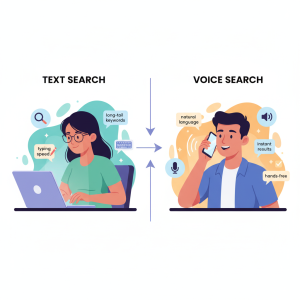
So, your content has to sound like it’s written for humans, not search engines.
Step 1: Optimize for Conversational Keywords
When people talk, they use questions and phrases, not keywords.
For example:
-
Typed: “digital marketing agency India”
-
Voice: “Which is the best digital marketing agency in India?”

To capture this, focus on:
-
Long-tail keywords
-
Question-based phrases (who, what, where, why, how)
-
Natural, conversational sentences
Example:
If you’re writing content for your business website, include headings like:
-
“What are the best ways to promote my business online?”
-
“How can startups use SEO to grow?”
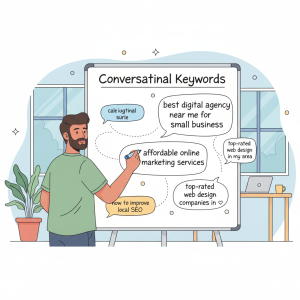
At Trafixo, we use advanced keyword research tools to identify voice-friendly queries that align with how your customers actually talk — not just type.
Step 2: Focus on Local SEO (Especially for Indian Businesses)
Most voice searches are location-based.
Think of searches like:
“Coffee shops open now near me”
“Plumber in South Delhi”
“Digital marketing company in Prayagraj”

To appear in those results, you need strong Local SEO.
How to Optimize for Local Voice Search
-
Claim and optimize your Google My Business listing.
-
Keep your NAP (Name, Address, Phone) consistent across all platforms.
-
Add business hours, photos, reviews, and directions.
-
Use phrases like “near me,” “in [your city],” and “open now” naturally in your content.
Example:
If you’re a café owner in Jaipur, make sure your Google Business Profile says “Best café near MI Road Jaipur” in your description or posts.
Trafixo helps businesses rank higher in “near me” and city-based searches through proven local SEO strategies.
Step 3: Improve Website Speed and Mobile Experience
Most voice searches come from mobile devices.
So, if your website loads slowly or isn’t mobile-friendly, Google will likely skip it.
⚙️ Voice SEO Checklist for Website Performance
-
✅ Make your site load in under 3 seconds
-
✅ Use responsive design
-
✅ Avoid heavy pop-ups
-
✅ Optimize images and code
Example:
Imagine a user says, “Hey Google, find digital marketing agencies near me.”
Google won’t recommend a site that takes forever to load — it wants fast, easy answers.
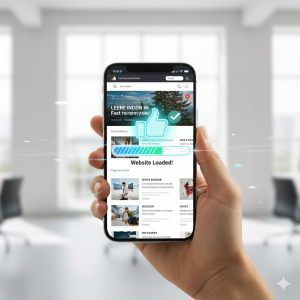
Trafixo’s web team ensures your site is optimized for mobile speed, SEO, and voice-readiness.
Step 4: Create Content That Answers Questions Directly
Voice assistants often pull answers from “featured snippets” — those short, boxed answers you see at the top of Google results.
To grab that position, write clear, direct answers in your content.
Example Format:
Question: What is voice search SEO?
Answer: Voice search SEO is the process of optimizing your website so it appears in voice assistant results when people ask questions aloud.
This helps Google quickly pick your content as the best match.
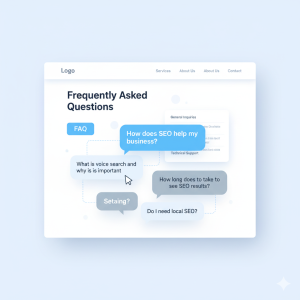
Pro Tip: Create an FAQ section on your website where you answer common voice-related questions.
Step 5: Use Structured Data (Schema Markup)
Structured data helps Google understand your website better — and that’s crucial for voice search.
Adding schema markup can help your business appear for things like:
-
Reviews (“Which bakery has 5-star ratings near me?”)
-
Events (“What events are happening near me this weekend?”)
-
Products (“Best affordable laptops under ₹50,000”)
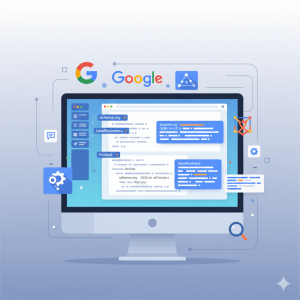
If Google understands your data clearly, it’s more likely to read your business as an answer to voice queries.
Trafixo helps businesses implement schema and structured data to boost their visibility in both text and voice searches.
Step 6: Optimize for Multiple Languages
India is a multilingual country — and voice search supports that diversity.
People might search in:
-
Hindi (“Mere paas best marketing company kaunsi hai?”)
-
Tamil, Telugu, Bengali, or even Hinglish.
If your business targets local regions, consider multilingual SEO.
Add local-language keywords, meta tags, and Google My Business descriptions.
Example:
A travel company in Kerala can add Malayalam translations for their service pages to reach regional voice users.
Step 7: Keep Your Brand’s Tone Natural
Remember, voice search SEO isn’t about stuffing keywords — it’s about sounding human.

Google is getting smarter with natural language processing (NLP), so write like you talk.
Instead of writing:
“Best SEO company India offering affordable SEO services.”
Write:
“Looking for a reliable SEO company in India that fits your budget? You’ve come to the right place.”
It feels friendly, approachable, and more in sync with how users speak.
Step 8: Track and Measure Your Voice Search Performance
Voice SEO is still evolving, but you can track progress using:
-
Google Search Console (for question-based queries)
-
Analytics (to see voice-like phrases)
-
Keyword tools like SEMrush or Ahrefs (for conversational keywords)
Set small goals — like ranking for specific question-based queries — and build from there.
At Trafixo, we continuously track how your site performs for both text and voice queries, making sure your brand stays ahead of SEO trends.
Real-World Example: How Voice Search Changes Customer Behavior
Let’s say you run a fitness studio in Mumbai.
Earlier, people would type:
“Gyms in Bandra”
Now, they simply say:
“Hey Google, what’s the best gym near me that’s open right now?”
That means Google looks for businesses with good reviews, optimized listings, and mobile-friendly websites.
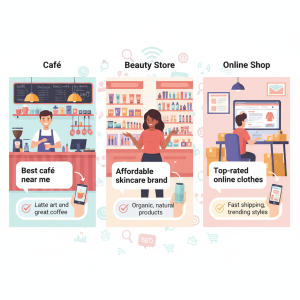
If your competitor has optimized for voice and you haven’t, guess whose gym will show up?
Voice search is not the future anymore — it’s the present reality.
hey appeared in featured snippets, driving voice-based traffic from Google Assistant users.
Common Mistakes Businesses Make with Voice SEO
Let’s save you from wasting time
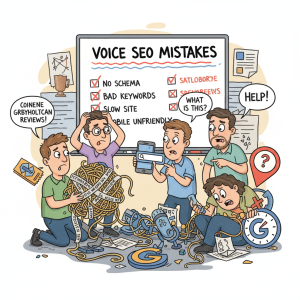
Using only short-tail keywords
✅ Instead, focus on long, question-style keywords.
Ignoring local SEO
✅ Most voice searches are local — don’t skip Google My Business.
Slow-loading website
✅ Page speed directly affects voice ranking.
No structured data
✅ Schema markup gives Google extra info to understand your business better.
Overly complex language
✅ Keep it simple — your content should be easy for both humans and voice bots to “read aloud.”
The Future of Voice Search SEO in India
Voice search is only going to get bigger. With AI assistants getting smarter and regional language support expanding, the next wave of internet users in India will use voice first.

In the next few years, we’ll see:
-
More “no-screen” searches (answers given directly through speakers)
-
Voice-based shopping and transactions
-
Localized content in regional languages dominating results
Businesses that adapt early will have a huge advantage over those who wait.
How Trafixo Can Help Your Business Get Voice-Search Ready
At Trafixo, we help Indian startups and businesses stay ahead of SEO trends.
Our expert team can help you:
-
Optimize your website for voice and mobile SEO
-
Build local SEO and Google My Business strategies
-
Implement structured data and schema markup
-
Create voice-friendly content that ranks for question-based queries

We combine technical expertise with smart content strategies — so your business isn’t just visible online, but easily found by voice assistants too.
Get your business voice-search ready with Trafixo and stay ahead in the digital future.
Final Thoughts

Voice search is transforming the way Indians use the internet — and it’s here to stay.
Whether your business is small or growing, optimizing for voice today means staying relev
ant tomorrow.
Start by making small changes — conversational content, local SEO, fast website — and
gradually build a voice-optimized presence.
The sooner you adapt, the better you’ll perform in a world where people talk to their devices more than they type.
We’ll help you stay visible, relevant, and ready for the next big wave of SEO in India.
✨ End Note
Voice search is changing the way people discover, compare, and connect with brands.
And the best part? It’s still early enough for smart businesses (like yours) to get ahead.
So, next time someone says, “Hey Google, find the best digital marketing agency in India,”
make sure the answer is — Trafixo.